Past Lives: NJC Lit Evening
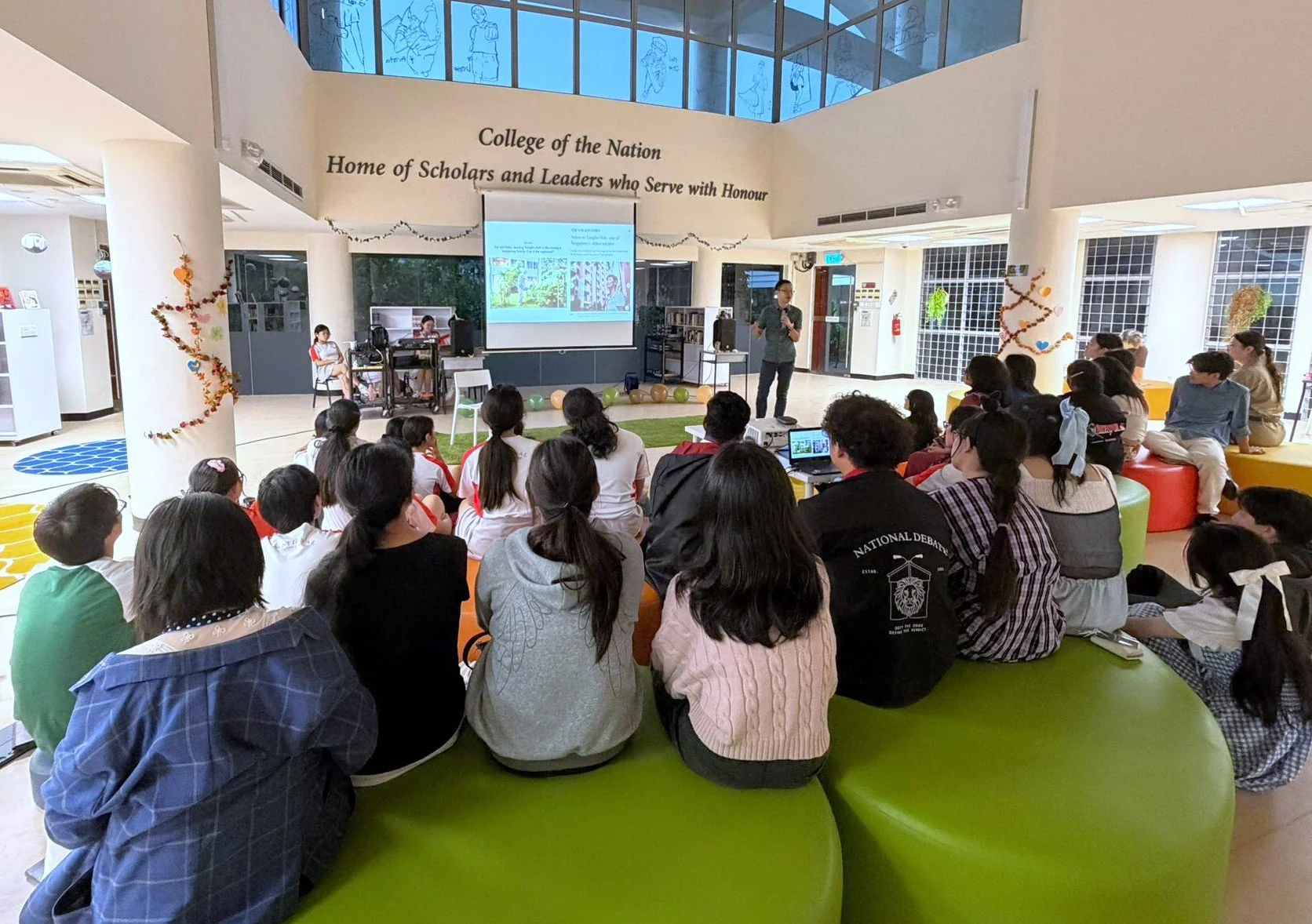
Speaking at the NJC Library to a fantastically costumed audience.
Was invited to speak at National Junior College (NJC)’s Lit Evening earlier this month, which was truly… lit. Kudos to the organisers, teachers (including fellow poet David Wong Hsien Ming) and the Book Bar team for making this such a memorable evening! Here’s what I said:
Your organisers have asked me to speak on the theme of ‘Crossroads’, inspired by the crossing of horizons and paths you find in a place like NJC. I suspect that on a personal level, some of you will also see your time here as a crossroads of sorts, a chance to decide on – or at least discover – the many possible plotlines your lives could take from this point. When I was in your shoes, that meant figuring out what to study at university; like many others, the path of least resistance was my favourite A-Level subject, which happened to be history. With the range of internship and gap year opportunities available to you today, I’m sure your choice is a much more complicated one.
What I want to do this evening is take you out of that frame of mind for a moment. To contemplate a set of crossroads invisible to those who see only with the eyes of the present, but which becomes obvious if we think about where we are through the lens of the past.
Here’s an example. I was last at NJC Lit Evening in 2019, on the invitation of another cohort of students very much like you – except they still had no inkling of the deadly virus that would be called COVID-19. Though they were wearing the same uniforms and may even have grown up with the same games and TV shows, those who filled your seats then had a very different understanding of the world from yours, just as many other teachers and writers have taken my place on this stage during the years in between.
Imagine meeting one of them after the event today, as you step out of these doors. It would be impossible to unlearn what you know of the world in 2026, but perhaps there would still be enough in common for you to imagine their state of mind – or even strike up a conversation.
Now cast your mind further back.
My first visit to the NJC campus was years before I even knew I would be a writer. I remember one weekend, when I was still in secondary school, attending a gathering here with my Dad. The exact occasion escapes me; it could have been a class reunion or some sort of commemoration. What I remember is how warm it was in the canteen, and how crowded – with people I didn’t recognise but who were obviously very happy to see him.
Dad was born the year after independence, and came to NJC in 1983 after collecting his O-Level results. At the time, Singapore would only have been at its current time-zone for one full year, having just moved to GMT +8.00 on 1st January, 1982. The first computer virus, and the first emojis, were invented that year. Michael Jackson was already the biggest star in the world, but he hadn’t yet performed the Moonwalk.
I wonder what the two years here were like for my Dad, the choices he made and what they meant to him. I know he was one of the thirty students who embarked on a hiking expedition in the Himalayas in 1985, half a year before their A-Levels. No big deal today, you might think, but they were the first Singapore school then to organise something like this – all thanks to one 31-year-old P.E. teacher who wanted her students to know that there was much more to life than the classroom.
Dad also picked up the harmonica, a popular fixture in what was then a rising wave of Singapore Mandopop. Just across the road in Hwa Chong, teenage heartthrob Liang Wen Fu was writing some of his most popular Xinyao ballads, two decades before winning the Cultural Medallion.
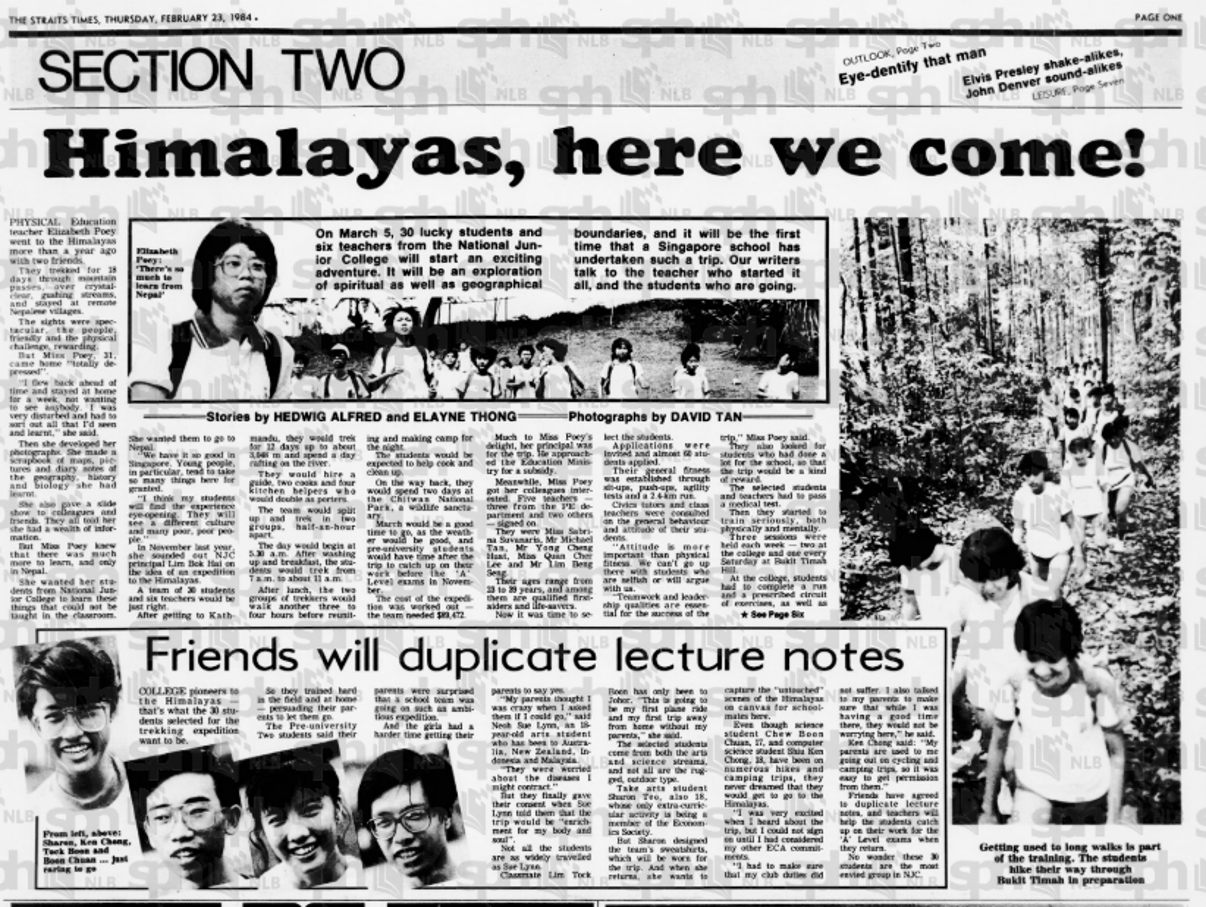
It’s impossible for me to visit NJC today without slipping, a little bit, into Dad’s shoes (which, incidentally, are more or less the same size as mine). Coming here, I can’t help but try to imagine how he inhabited this space forty years ago and made it his own, just as you have all claimed the campus for yourselves. Of course, as difficult as it is for us to know what any other person is thinking at any time, it can feel impossible to put ourselves in the mind of people and communities in the past. Yet as we go about our lives in the city of the present, we cannot escape them.
The experiences of all those who have sat in these seats or walked through these gates overlap with our own, alternate realities from a different time. And in this way the past continually haunts the present; both in the stories we we’ve been told, and in the questions that remind us how little it is that we actually know.
These are the crossroads I am most interested in: the criss-crossing of lives over time, footsteps from another dimension that pause at the same junction, cross the same street. The places we know well are transformed as we imagine the trails of different footprints that have left their mark, each adding something to the landscape. At the same time, our own paths seem less pre-determined, as we imagine all those who have found themselves in the same spot, but chose to go another way.
When I was writing the poems in my book Commonwealth, I found myself going back to the Tanglin Halt estate again and again. Initially, this was to understand the perspective of elderly residents who were told in 2014 that their estate was going to be redeveloped. Understandably, their memories were steeped in grief and nostalgia; many had never thought that they would have to leave behind their homes of many years.
But as I read more about the history of the estate, part of the HDB’s first project in Queenstown, I started to think about a group of younger residents from fifty years before who found themselves moving into high-rise housing for the first time. Some – like my maternal family, who were assigned a flat across the road at Commonwealth Crescent – were the same households displaced by the massive fires at Bukit Ho Swee. For these residents, fear and uncertainty was in the air, but also curiosity about this new way of life, and a sense of hard-won wonder and hope.
To take any one of these emotions as the story of Tanglin Halt would be like flattening our memory of this neighbourhood, even before it has been fully demolished in real life. Between the two groups of residents I described – moving in and out of the estate fifty years apart – some are in fact the very same individuals and families whose lives have changed immeasurably in between. The crossroads they see here are the paths taken by their own younger selves, traversing the same square to catch a bus to the city in the days before Commonwealth MRT was built.
When they return to the estate in just a couple of years’ time, when the redevelopment works are complete, new paths will have been laid and paved over, marking new sorrows and new beginnings here.
One poem where I try to capture these different voices over time is ‘Chap Lau Chu’, which takes its name from the ten-storey blocks that were a defining feature of the Tanglin Halt estate. The poem, which is in ten parts, alternates between what I think of as the voice of memory and recollection – the voice of the poet – and another voice which hews more closely to the residents’ own, collected through oral history interviews before they moved out. I wanted this poem to be a microcosm of the book, to contain a cacophony of voices that defy the idea of a single Tanglin Halt narrative.
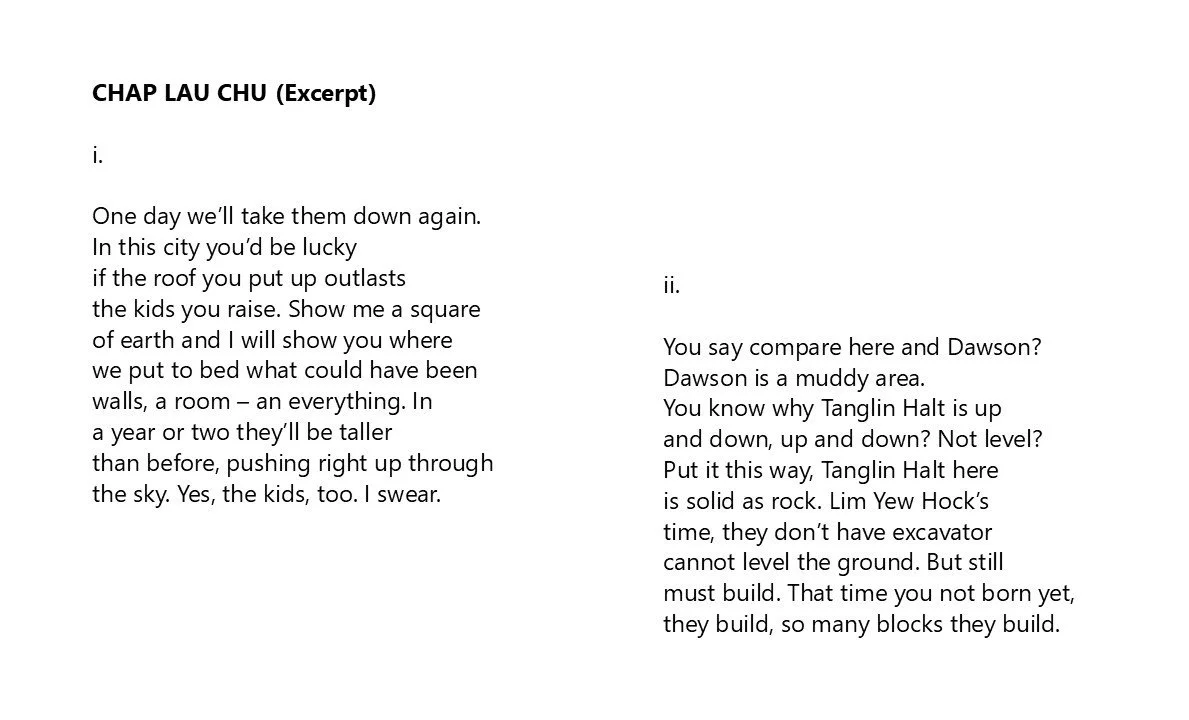
I had the opportunity to read part of this poem at an event in the UK last year, where the Irish poet Vona Groarke said something beautiful in response. Instead of thinking of our books as collections of poems, she suggested, we could treat them as communities of poems – each book making space for a meeting of different voices, filtered through the voice and perspective of the poet. For those of you who write, what sort of community do you imagine your poems and stories to be?
With Lunar New Year just behind us, I imagine Commonwealth to be a reunion dinner of sorts, uncles and aunties chiming in with old yarns to tell their unsuspecting grandkids. The best books of poems, I think, are crossroads in their own right, with every page affording you the surprise of an unexpected voice.
***
Now that Commonwealth is out in the world, let me close by telling you a bit about my next project, Odeon, which I’m fortunate to be publishing with Ethos Books later this year. Rather than a book of poems, this one mixes fiction and nonfiction to tell the story of the former Odeon Cinema on North Bridge Road.
I got interested in this building because my friend Rubel, who was a migrant worker in Singapore, was the safety supervisor on the site when it was being rebuilt right after COVID-19. Admittedly, there’s plenty I don’t know about what this would’ve been like – I imagine long hours under the hot sun, plus the burden of keeping a large team of workers, far from home and all speaking different languages, out of harm’s way. But I started thinking about the many other lives that would have criss-crossed over this site, from the local teachers who met at the union offices upstairs to fight for equal pay with their colonial counterparts, to the bright-eyed badminton players who came here to compete in the first Singapore Open championships of 1929.
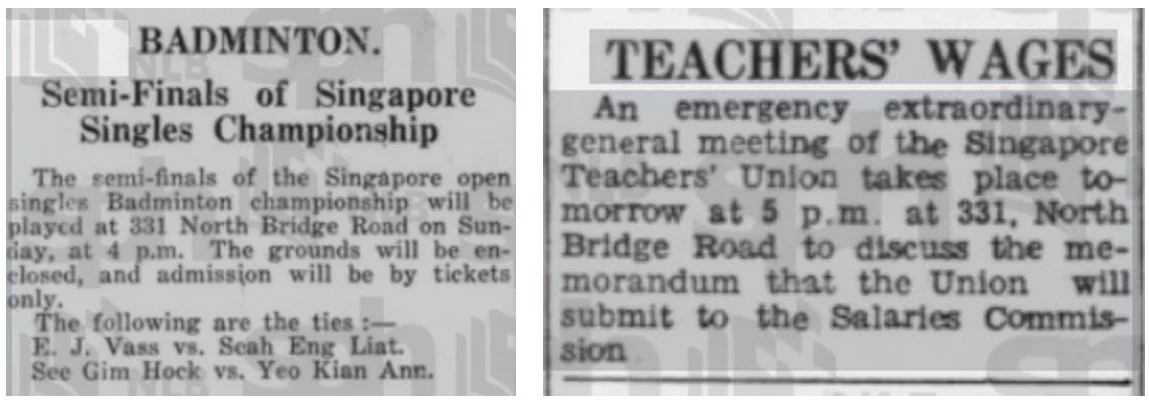
History rarely gives us all the answers, and there’s a lot I don’t know about these lives as well. With some research and imagination, it’s possible to fill in some of the gaps. But what I do know for certain is this – that like my friend Rubel, all of these people made their way to this address, 331 North Bridge Road, and were transformed by the choices and decisions that took place here. And putting their stories together, it’s clear that the Odeon building isn’t just a personal crossroads for each of them, but also one of those crossroads of history that weaves many plotlines together to illuminate the present.
The more time I spend in the shadow of this old cinema, the more I get the feeling one has sometimes when you enter a movie theatre and leave a little while later, a different person altogether.
As you step out of the hall this evening, let me encourage you to look a little closer at the world, not only with the eyes of the present but of the past. And spend some time if you can with the voices you discover, how they imagine the world and how they chose to move through it. I guarantee you’ll be surprised, as I find I am, again and again. Because that’s the thing about crossroads – they show you there’s always another way.